

A mid-sized petroleum distributor based in Cebu, Philippines, operates a network serving 85 retail petrol stations and 120+ commercial clients — construction firms, fishing fleets, and agricultural cooperatives — across the Visayas and northern Mindanao regions. The company's legacy fleet mixed Flatbed Trailers carrying drummed fuel, second-hand Japanese tankers with unknown maintenance histories, and rented third-party trucks during peak demand periods. This fragmented fleet structure created three compounding problems: high fuel consumption from overweight trailers, corrosion-related downtime in a tropical marine environment, and unpredictable per-litre delivery costs that made contract pricing nearly impossible.
The trigger for change came when the company won a three-year exclusive supply contract with a national fishing port authority, requiring guaranteed 48-hour delivery on diesel orders up to 30,000 litres — a volume their existing fleet could not reliably meet without subcontracting. The contract penalty clause for late delivery was steep enough that fleet reliability became an existential business risk, not just an operational concern.
After a competitive tender involving Chinese, Indian, and Turkish manufacturers, the distributor ordered seven Hualu Tank Trailers in a 3-axle configuration with 40,000-litre capacity per unit. The trailers were delivered in two batches over a four-month period, replacing nine legacy trucks and eliminating the need for peak-season rentals entirely.
Key technical specifications of the delivered units:
After 12 months of operation covering approximately 840,000 kilometres across the fleet, the data validated the investment case:
| Performance Indicator | Legacy Mixed Fleet (Baseline) | Hualu Tank Fleet | Change |
|---|---|---|---|
| Fleet size required for contract volume | 9 trucks + 2 rental | 7 trucks | -36% |
| Fuel consumption (tractor-trailer, L/100km) | 38.5 | 32.7 | -15% |
| Annual diesel cost for fleet | Baseline | ~$48,000 saved/year | Significant |
| Unscheduled maintenance events/year | 14 (fleet total) | 3 (fleet total) | -79% |
| Average delivery lead time | 52 hours | 31 hours | -40% |
| Contract penalty incidents | N/A (new contract) | 0 | 100% compliance |
The 15% reduction in fuel consumption was driven primarily by the 600 kg weight advantage per trailer. Over 840,000 fleet kilometres at Philippine diesel prices, the fuel saving alone recovered approximately 18% of the total trailer acquisition cost within the first year. Combined with the elimination of peak-season rental costs and reduced subcontracting fees, the company's CFO projected full investment payback within 26 months of deployment.
The Philippines presents one of the most aggressive corrosion environments for transport equipment anywhere in the world. Average relative humidity exceeds 80% year-round, coastal routes expose trailers to salt spray on a daily basis, and tropical rainfall exceeds 2,000 mm annually across the distributor's operating area. Standard carbon steel tankers in this environment typically require major corrosion repair — sandblasting, re-welding of pitted sections, and full recoating — within 3–4 years of service.
Hualu's corrosion protection specification for this contract included three layers beyond the industry standard: a zinc-rich epoxy primer with 80% zinc content by weight in the dry film (providing cathodic protection to the steel substrate), an intermediate epoxy tie-coat for adhesion, and a marine-grade aliphatic polyurethane topcoat with UV stabilisers. The shot-blast surface preparation to SA 2.5 standard — removing all mill scale and achieving a 50–75 μm anchor profile — ensures mechanical adhesion far superior to the power-tool cleaning (St 2–3) commonly used by budget manufacturers.
At the 12-month inspection, no visible corrosion was present on any of the seven trailers, and ultrasonic thickness measurements confirmed less than 0.1 mm of metal loss across all measured points — well within the design corrosion allowance for a projected 12–15 year service life in the tropical marine environment.
A frequently overlooked capability of the Hualu tank trailer is the 4-compartment design. For the Filipino distributor, this enabled a single truck to deliver diesel to a fishing port, gasoline to a retail station, and kerosene to a rural cooperative — all on the same route, without returning to the depot between stops. Before the fleet upgrade, each product required a dedicated truck because the legacy tankers were single-compartment designs inherited from different previous owners.
The multi-compartment capability reduced the average number of daily depot returns from 2.2 to 0.8, saving approximately 140 kilometres of deadhead driving per truck per day. Across seven trucks and 300 operating days, this eliminated roughly 294,000 kilometres of non-revenue driving annually — equivalent to removing 1.5 trucks from the fleet purely through routing efficiency.
What distinguishes this deployment from a standard equipment purchase is the strategic logic: transitioning from a mixed fleet to a single-commodity, single-manufacturer tank trailer fleet. The distributor's management recognised that operating three different tanker brands with three different spare parts inventories, three different maintenance schedules, and three different driver training requirements was a structural cost that no single trailer purchase could solve. Standardising on the Hualu platform eliminated this invisible overhead.
Specifically, the company reduced its spare parts inventory from 340 SKUs across five trailer types to 82 SKUs for a single platform. Driver training time for new hires dropped from three weeks to five days, as every trailer in the fleet operated identically. Maintenance staff no longer needed to consult five different service manuals. These are not glamorous savings, but they are real, compounding, and permanent — and they do not appear on any trailer specification sheet.
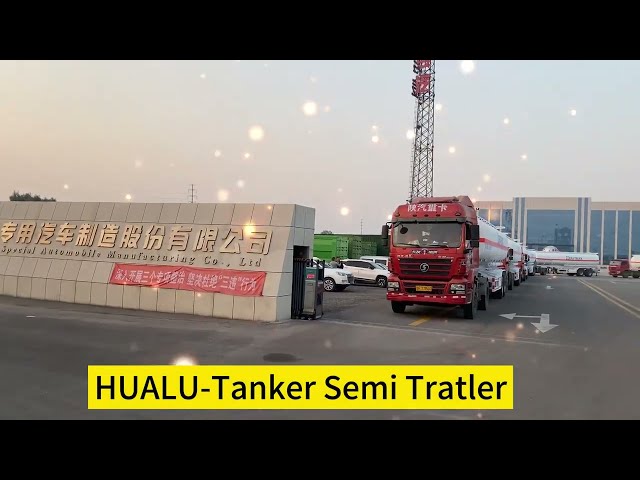
Every Hualu tank trailer is manufactured by Liangshan Hualu Special Automobile Manufacturing Co., Ltd. — a factory-direct manufacturer established in 2001 with a 150,000 m² production facility in Shandong, China, employing over 360 staff including 20+ senior engineers. The company operates under ISO 9001:2015 quality management and holds CCC, ISO/TS 16949, CE, DOT, and MIIT certifications with over 50 patented technologies.
Hualu exports to over 30 countries across Southeast Asia, Central Asia, the Middle East, Africa, and South America. A dedicated international after-sales team provides remote technical support, on-site commissioning, and operator training worldwide. For specific tank trailer configurations, hazardous materials compliance documentation, and delivery timelines to your region, please contact the Hualu sales team.