

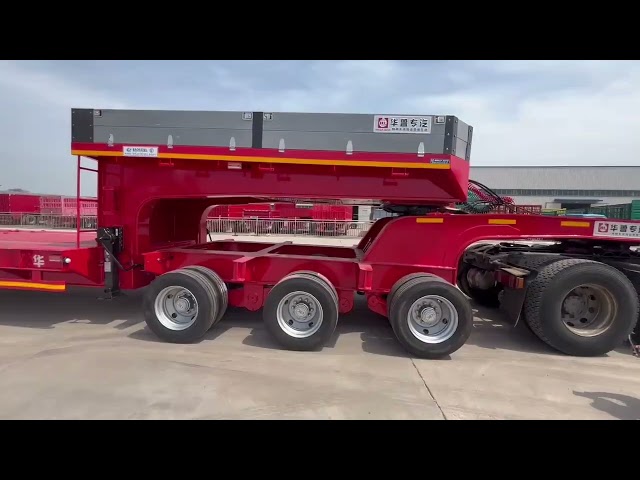
Route 23-CH climbs from the Chilean coastal city of Antofagasta to the copper mines of the Atacama Desert plateau. In 180 kilometres, it gains 2,500 metres of elevation, passing through temperature swings of 35°C between the morning coastal fog and the midday high-altitude sun. For a Santiago-based mining services contractor that moves excavators, bulldozers, drill rigs, and articulated dump trucks between mine sites and sea-level maintenance yards, this road is not a route — it is a stress test that every piece of equipment must pass twice per move, once loaded uphill and once empty downhill.
The company's fleet manager, a mechanical engineer with 22 years in Chilean mining logistics, summarised the problem in a quarterly review meeting: "Our trailers spend more time being welded than being driven." The existing fleet of eight ageing lowboy trailers — a mix of Brazilian and Chinese units purchased over a decade — recorded 23 structural cracking incidents in a single year. The cracks appeared in predictable locations: main beam web plates at the gooseneck transition, cross-member welds at the suspension mounting points, and deck plate seams where concentrated loads from excavator tracks created localised stress. Each crack meant 3–5 days of workshop downtime, a replacement rental trailer at roughly $850 per day, and a delivery delay that cascaded into mine-site equipment availability.
The contractor's engineering team conducted a metallurgical analysis of the cracked sections. The findings were unexpected. The trailers were not being overloaded — the excavators transported weighed 38–48 tonnes, well within the trailers' 60–80 tonne ratings. The cracking was thermal fatigue. Daily temperature swings of 35°C, combined with the rapid cooling that occurs when a trailer loaded with a hot excavator descends from the desert plateau into the coastal fog bank at 800 metres, created expansion-contraction cycles that standard structural steel was not designed to absorb. The Brazilian-built trailers used ASTM A572 Grade 50 steel — adequate for most applications, but not for the thermal duty cycle of Andean mining logistics.
The fleet manager's team specified the replacement requirement: a lowboy trailer built with steel that could handle thermal cycling without crack propagation, on a timeline that would not disrupt the upcoming contract season.
After visiting three Chinese manufacturers, the contractor ordered seven Hualu Lowboy Trailers — four 3-axle 60-ton units for excavators and bulldozers, and three 4-axle 80-ton extendable units for drill rigs and long-track equipment. The specification included several features that were not standard in the contractor's previous fleet:
The seven Hualu lowboys entered service in Q4 2023. After twelve months and approximately 430 equipment moves, the fleet data showed clear divergence from the performance of the trailers they replaced:
| Metric | Old Fleet (2022–2023) | Hualu Fleet (2023–2024) | Change |
|---|---|---|---|
| Structural cracking incidents (yearly) | 23 | 1 | -96% |
| Unplanned workshop days (yearly total) | 87 | 6 | -93% |
| Rental trailer cost (annual) | ~$74,000 | ~$5,100 | -93% |
| Average load/unload time | 38 minutes | 19 minutes | -50% |
| Moves completed per trailer per month | 3.8 | 5.1 | +34% |
| Tyres replaced (annual, fleet total) | 18 | 8 | -56% |
The single structural incident on the Hualu fleet was a hairline crack at a tie-down ring weld — detected during a routine inspection, repaired in 4 hours, and traced to an impact from a swinging excavator bucket during loading. It was classified as operational damage, not a design or material deficiency.
The 93% reduction in rental trailer expenditure — from approximately $74,000 to $5,100 annually — was the line item that the contractor's finance director highlighted to the board. "The rental cost under the old fleet was not a contingency budget," he noted. "It was a predictable annual expense dressed up as an unpredictable one."
The fleet manager's quarterly report contained an observation that summarised the operational difference: "The safety orange colour is not cosmetic. When you are loading a 48-tonne excavator at 06:00 in the camanchaca — the coastal fog that reduces visibility to 20 metres — the trailer deck needs to be visible. The old trailers were dark grey. The operators could not see the deck edge. Now they can. That is not a paint decision. That is a safety decision."
The camanchaca fog, which rolls in from the Pacific Ocean most mornings between May and November, had been a contributing factor in two near-miss loading incidents on the previous fleet — both involving the excavator operator losing visual reference of the trailer deck position. No such incidents occurred with the Hualu fleet, where the orange deck outline remained visible through the fog layer.
The operating conditions on Route 23-CH — extreme elevation change, daily thermal cycling, abrasive desert dust, and corrosive coastal fog — represent a compressed version of challenges that mining and construction logistics operators face in different combinations worldwide. Andean mining is not unique in its severity; it is unique in that it combines multiple severity factors on a single route. A trailer that survives twelve months on this road without structural cracking has demonstrated a level of fatigue resistance that translates directly to longer service life in less extreme environments — from Australian iron ore routes to Canadian oil sands operations to Indonesian coal corridors.
The Hualu Lowboy Trailer platform is configurable for axle count, deck length, gooseneck type, and loading system, with a standard production lead time of approximately 35 days from order confirmation to FOB Qingdao — a timeline the contractor specifically cited as enabling their fleet replacement without disrupting the 2023–2024 contract season.
Every Hualu trailer is manufactured by Liangshan Hualu Special Automobile Manufacturing Co., Ltd. — established in 2001, 150,000 m² facility in Shandong, China, 360+ employees. The company holds CCC, ISO 9001:2015, ISO/TS 16949, CE, DOT, and MIIT certifications, with over 50 patented technologies. Hualu exports to 30+ countries worldwide. For lowboy trailer specifications, axle configurations, and mining logistics planning support, contact the Hualu sales team.