

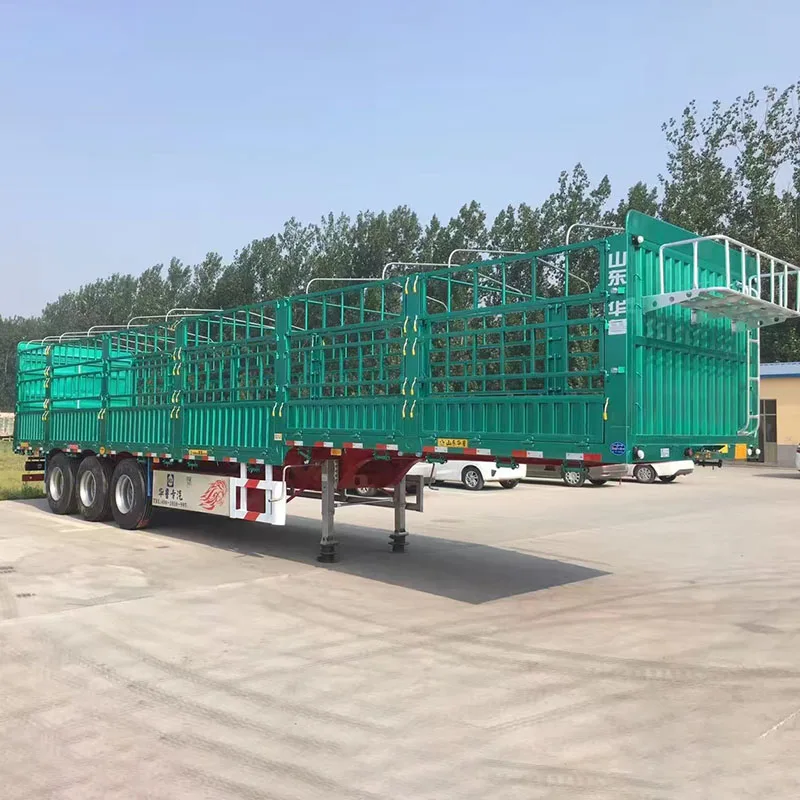
In March 2026, a fleet operator from Argentina arrived at Hualu’s manufacturing facility, grappling with soaring fuel prices, escalating labour costs, and razor‑thin profit margins that threatened the viability of his overland freight business. After intensive on‑site consultations, Hualu’s engineering team designed a versatile fence semi‑trailer that redefines operational efficiency. This tailor‑made asset not only slashes deadweight but also multiplies cargo flexibility, incorporating removable side rails, heavy‑duty lashing gear, a protective tarp system, and an optional air‑suspension lift – all integrated to boost payload, cut fuel consumption, and raise net returns by a tangible 20%. The following four pillars detail how this innovation turned a struggling balance sheet into a competitive edge.
1. Multi‑Cargo Adaptability with Removable Fencing
The trailer’s defining feature is its modular fence structure – sturdy vertical and horizontal rails that can be swiftly unbolted and detached in the field. When fully assembled, the fence secures palletised bagged bulk commodities (fertilisers, grains, and mineral powders) and tightly packed silage bales for livestock feed. With the rails removed, the flatbed becomes an open platform ideal for heavy machinery – excavators, rollers, or agricultural tractors – as well as construction materials like steel beams, precast concrete panels, and timber logs. This chameleon‑like capability allows the Argentine operator to accept diversified freight contracts on backhaul routes, eliminating empty runs and dramatically improving asset utilisation across the Pampas and Andean foothills.
2. Robust Cargo Securement and All‑Weather Protection
Safety and load integrity are paramount, especially on long hauls across uneven terrain. Hualu outfitted the trailer with extra‑strength ratchet tie‑downs – forged steel winches and heavy‑duty straps positioned at strategic intervals along both sides and the front bulkhead. These tensioners withstand extreme vibration and lateral forces, preventing any shift or spillage of loose goods or oversized equipment. Complementing the lashing system is a full‑cover PVC tarpaulin that rolls out from a dedicated storage rack mounted just behind the gooseneck. The tarp shields hygroscopic cargo from sudden rainstorms and minimises dust infiltration on gravel roads. Moreover, the same rack can double as a secondary cargo carrier – securely holding long pipes, rolled fencing wire, or spare tyres – turning wasted overhead space into a practical stowage area without compromising stability.
3. Air Suspension with 8 cm Lift and Significant Weight Reduction
To conquer Argentina’s varied loading docks and rough farm tracks, the trailer is equipped with a self‑levelling air‑bag suspension that provides an overall chassis lift of approximately 8 centimetres at the flick of a dash‑mounted switch. This raising function eases coupling/uncoupling, clears low obstacles, and adjusts the deck height for forklift or ramp access. More critically, the entire suspension and subframe architecture was re‑engineered using high‑strength micro‑alloy steel and aluminium cross‑members, shedding nearly 2 tonnes of tare weight compared to conventional leaf‑spring designs. The resultant mass saving directly translates into lower fuel expenditure per kilometre – a vital relief when diesel prices climb unpredictably – and also reduces tyre wear and brake stress, cutting routine maintenance downtime and workshop bills.
4. Payload Gain, Profit Uplift, and Labour Efficiency
The most compelling outcome of Hualu’s lightweight yet rugged build is a staggering 4.5‑tonne increase in legal payload capacity (under Argentine gross‑weight regulations), while the trailer’s structural rigidity remains intact. For a typical round‑trip of 1,200 km carrying bagged feed, this extra tonnage means more revenue per journey without additional fuel or toll costs. The operator reported a verified 20% improvement in net profit margin over the first three months of service, attributable not only to the payload bonus but also to faster loading/unloading – thanks to the detachable rails and the tarp rack that eliminates separate crane handling for covers. Labour costs shrink because one driver can now secure diverse loads single‑handedly with the intuitive winch system, and the air suspension’s height control reduces physical effort during dock alignment. In an era of relentless cost pressure, this Hualu semi‑trailer delivers a resilient, future‑proof answer – proving that smart engineering, not just brute capacity, drives sustainable growth for South American fleets.
1.More product cases - Belt semi trailer
2.More product cases - Lowbed semi trailer
3.More product cases - Fence semi trailer