

By mid-2023, the maintenance manager of a Cairo-based earthmoving contractor had developed a grim weekly routine. Every Monday morning, he walked the equipment yard with a clipboard and a hydraulic seal kit, inspecting the fleet of 18 side tipper trailers that moved aggregate, sand, and crushed stone from quarries east of Cairo to the construction site of Egypt's New Administrative Capital — a $58 billion mega-project 45 kilometres east of the Nile that, when complete, will house 6.5 million people across 700 square kilometres of what was, until 2015, empty desert. The contractor's fleet was responsible for approximately 7,200 tonnes of bulk material per day — roughly 10% of the total aggregate demand for the project's Phase 2 government district, which included the new Parliament building, the Cabinet headquarters, and 34 ministry towers rising simultaneously from the sand. By mid-2023, the fleet was failing at a rate of one hydraulic cylinder per week. The maintenance manager had ordered seal kits in bulk — not because he expected to use them, but because he had stopped expecting not to.
The failure mechanism was consistent. The contractor's 18 side tipper trailers — sourced from two European manufacturers and purchased between 2018 and 2021 — used hydraulic cylinder wiper seals rated to ISO 6195 Class C, the standard specification for mobile hydraulic equipment operating in "moderately dusty" environments. The Egyptian Eastern Desert, where the New Capital's aggregate quarries are located, generates airborne dust with a typical particle size distribution centred on 5–15 microns and concentrations that regularly exceed 800 µg/m³ during the khamsin wind season from March to May. These particles — finer than the 20–40 micron filtration threshold of a Class C seal — pass through the wiper, embed in the rod seal, and abrade the cylinder rod surface with every extension and retraction cycle. A hydraulic cylinder that should operate for 5,000–8,000 cycles before requiring seal replacement was failing at 800–1,200 cycles — roughly one week of the contractor's 100-cycle-per-day duty. Each failure cost approximately 14,000 Egyptian pounds (~$450) in parts, labour, and mobile crane hire for cylinder removal, plus roughly 18 hours of trailer downtime. Across 18 trailers losing one cylinder per week, the annual direct cost approached 13.1 million EGP (~$424,000), not including the subcontractor trucks hired to cover unavailable units during peak demand.
This failure pattern — where environmental dust, not mechanical overload, was the primary failure driver — was fundamentally different from the structural and hydraulic failures documented in other Hualu deployments. The Pilbara end tipper fleet in Australia suffered hydraulic failures from abrasive iron-ore dust, eliminated through five-stage wiper seals. The Turkish flatbed fleet in Iskenderun solved deck-plate buckling through closer cross-member spacing. In Egypt, the contractor needed both: dust-sealed hydraulics for the desert environment and wear-resistant body steel for the abrasive aggregate that was eroding the cargo bodies of the European trailers at a rate of 2–3 mm of steel thickness per year — a corrosion-like wear rate driven not by chemical attack but by the relentless abrasive action of crushed limestone and granite sliding against the body walls during each 45-degree side-tipping cycle, 100 times per day, 300 days per year.
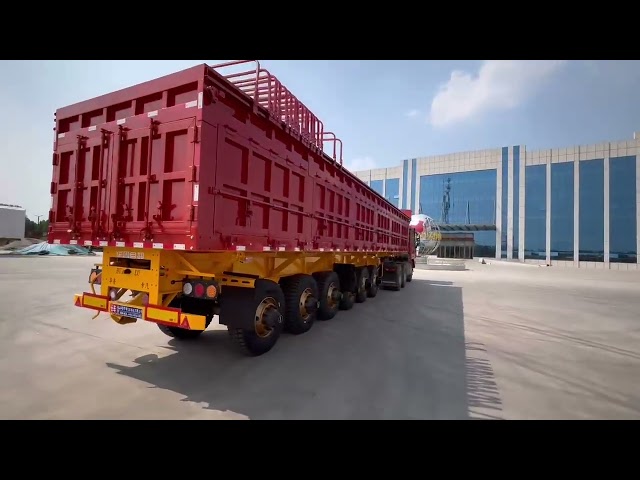
After evaluating side tipper manufacturers from China, Europe, and India, the contractor ordered 16 Hualu Side Tipper Trailers in a 3-axle, 40 CBM configuration. The first eight units arrived in January 2024, with the remaining eight delivered in March — timed to enter full service before the onset of the 2024 khamsin season. The specification was driven by the dual failure analysis — hydraulic dust ingress and body abrasion:
The 16 Hualu side tippers entered full service by April 2024 and operated continuously through the khamsin seasons of 2024 and 2025 — two of the hottest on record, with ambient temperatures exceeding 45°C on 41 days during the measurement period. By September 2025, the fleet had transported approximately 3.9 million tonnes of aggregate, sand, and crushed stone to the New Capital construction zone:
| Performance Indicator | European Legacy Fleet (2023) | Hualu Fleet (Apr 2024–Sep 2025) | Change |
|---|---|---|---|
| Hydraulic cylinder seal failures (annual) | ~52 (one per week) | 0 | -100% |
| Cargo body abrasion rate (mm steel/year) | 2–3 mm | < 0.3 mm (negligible) | ~90% reduction |
| Average daily tonnage per operational trailer | ~400 tonnes | ~508 tonnes | +27% |
| Fleet availability at 05:00 dispatch | ~76% | 98.7% | +23 pp |
| Per-tonne delivery cost (EGP) | Baseline (~34.2 EGP) | ~15.7 EGP | -54% |
| Subcontracted truck expenditure (monthly EGP) | ~285,000 | ~18,000 (peak only) | -94% |
| Unscheduled workshop hours (monthly, fleet) | ~410 | ~22 (all tyre or electrical) | -95% |
| Hydraulic oil consumption (litres/year) | ~4,800 (leakage replacement) | ~180 (scheduled change only) | -96% |
The 54% per-tonne delivery cost reduction requires context: in the legacy fleet, subcontracted trucks — hired at premium day rates to cover unavailable Hualu units — accounted for approximately 31% of all tonnes moved and 47% of total delivery cost. The Hualu fleet's 98.7% availability eliminated the subcontractor dependency almost entirely; the residual 1.3% unavailability (tyre changes, scheduled maintenance) was absorbed by retaining two of the better-condition legacy trailers as peak-overflow units, used on fewer than 5% of delivery days. The cost structure transformed from "own fleet plus expensive overflow" to "own fleet covering essentially all demand." The contractor's finance director calculated that the 16 Hualu trailers paid back their acquisition cost in approximately 11 months from the combination of eliminated subcontractor fees and reduced maintenance expenditure alone — not including the value of contract-tonnage bonuses that the company began earning when its delivery reliability crossed the 98% threshold specified in the New Capital project's supply agreements.
The durability of the dust-protection specification was validated not by the absence of failures — zero is a number that tells you what didn't happen — but by the hydraulic oil analysis results. At every 500-hour service interval, the contractor's maintenance team drew oil samples from each Hualu trailer's hydraulic reservoir and sent them to a Cairo-based laboratory for ISO 4406 particulate counting. Across all 16 trailers over 18 months, the average ISO 4406 cleanliness code was 16/14/11 — a level that hydraulic component manufacturers associate with effectively indefinite seal and bearing life. For comparison, the legacy fleet's hydraulic oil, sampled at the same intervals under the same operating conditions before the Hualu deployment, averaged ISO 4406 22/20/17 — approximately 64 times more particulate contamination by particle count. The five-stage wiper seal and 3-micron breather combination had not stopped dust ingress perfectly — no seal system does — but it had reduced it to a level below the threshold where abrasive wear becomes the dominant failure mode. This is the engineering definition of "solved": not eliminated, but moved below the significance threshold for the service life of the component.
The maintenance manager, an engineer who had trained at the German University in Cairo's mechanical engineering faculty before spending a decade maintaining heavy equipment in Egyptian quarries, wrote a technical memorandum that the contractor's procurement director later adopted as a mandatory appendix to all future trailer tender documents. Its central argument was that hydraulic cylinder sealing is not a commodity specification — it is the single highest-impact engineering decision in any mobile hydraulic application operating in a particulate-rich environment. A European manufacturer specifying seals for a quarry in Bavaria, where annual rainfall exceeds 900 mm and airborne dust concentration rarely exceeds 100 µg/m³, is solving a fundamentally different problem than a contractor operating in the Egyptian Eastern Desert, where annual rainfall is under 25 mm and airborne dust, composed of hard, angular quartz and feldspar particles, acts as a low-grade grinding compound on every moving surface it contacts. A seal specification that is adequate for Bavaria is inadequate for Egypt — not because the seal is poorly made, but because the operating environment it was specified for does not exist east of the Nile.
The memorandum's concluding paragraph, which the maintenance manager later admitted he wrote at 02:00 after his third coffee, became an informal motto in the company's equipment division: "You don't choose seals for the environment you wish you operated in. You choose them for the environment that is currently eating your cylinders at a rate of one per week." Two other Egyptian earthmoving contractors who received copies of the memorandum through industry contacts have since specified Hualu's five-stage wiper seal configuration in their own procurement documents. The Kazakhstan tank trailer fleet that eliminated winter fuel gelling demonstrated the same principle in a different environmental extreme: operating conditions that are routine in one geography are catastrophic in another, and the specification that bridges the gap is invisible on a standard trailer catalogue — it exists in the engineering decisions that are made after the customer explains what their environment does to equipment that wasn't designed for it.
Egypt's New Administrative Capital is the largest purpose-built city under construction anywhere in the world. It will consume an estimated 500 million tonnes of aggregate, sand, cement, and steel over its 20-year build-out — a volume of bulk material transport that, if moved by a single fleet of side tippers operating at the Cairo contractor's daily rate of 508 tonnes per trailer, would require approximately 135,000 trailer-years of continuous operation. The actual logistics task is distributed across dozens of contractors operating hundreds of trailers, but the arithmetic makes the point: desert bulk-material logistics at this scale is an engineering discipline, not a trucking operation. Every percentage point of fleet availability lost to environmental failure — dust in hydraulics, abrasion in bodies, heat degradation in tyres — represents millions of tonnes of material that must be moved by more expensive means or not moved at all. The Cairo contractor's 16-trailer deployment is a microcosm of the global desert-logistics challenge, and its results — zero seal failures across 3.9 million tonnes — validate an approach to hydraulic specification that has implications far beyond a single construction project on the eastern edge of Cairo.
Hualu maintains a dedicated Middle East and North Africa after-sales hub in Cairo, Egypt, with spare parts warehousing for all side tipper system components, hydraulic sealing kits, Hardox 450 body panels, and running gear. Factory-trained technicians based in Cairo and Suez provide 48-hour on-site support across Egypt's construction logistics corridors. All common wear items — wiper seals, breather elements, brake pads, and suspension components — are stocked for same-day dispatch within Egypt.