

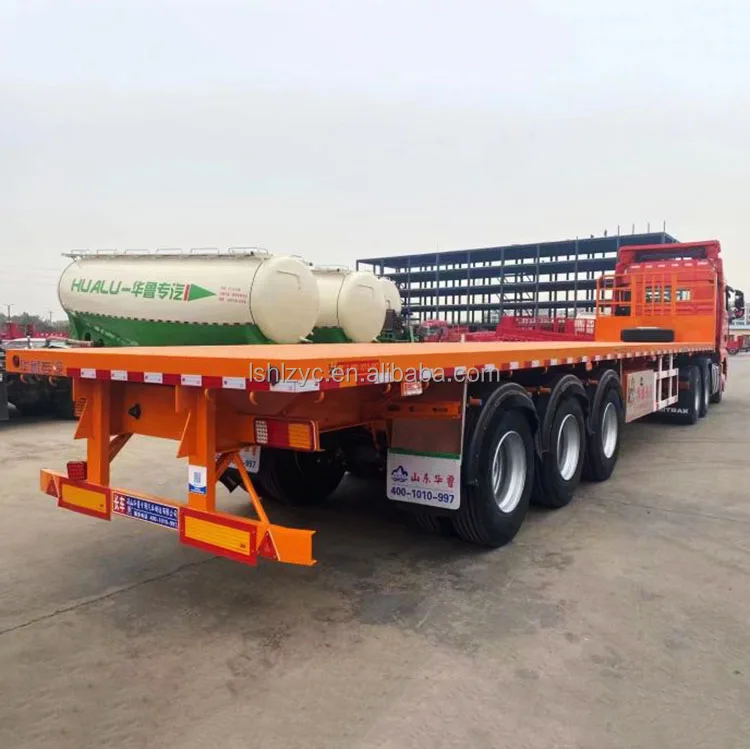
From the Red Sea to the Gulf, Saudi Arabia’s freight corridors demand versatility, durability, and precision. Hualu’s 3‑axle 60+ ton flatbed semi‑trailer – equipped with a front bulkhead – has become a trusted workhorse. But the real game‑changer is full customisation: axle numbers from 3 to 6, deck lengths up to 17 metres, and payload ratings tailored to each operator’s needs. This adaptability, combined with a proven 12% net profit boost, makes Hualu the preferred partner for Saudi logistics firms handling containers, steel, cement, and heavy machinery – across scorching deserts and congested port approaches.
1. The Crushing Bottleneck
At Jeddah Islamic Port, one mid‑sized logistics company was haemorrhaging money. Their fixed‑spec 3‑axle trailers maxed out at 55 tonnes and couldn’t handle the mixed loads arriving daily – 40ft boxes, palletised cement, and oversized steel coils. Every shift, they faced empty backhauls because their trailers were too short for construction beams and too rigid for bagged cargo. Fuel bills spiked 18% year‑on‑year, and frequent brake‑related cargo shifts caused damage claims that ate 5% of gross revenue. Fleet director Faisal Al‑Ghamdi knew he needed a platform that could morph with his job‑mix – not a one‑size‑fits‑all box.
2. The Tailored Hualu Solution
Faisal’s team sat with Hualu engineers and specified a 4‑axle configuration – instead of the standard 3 – to distribute the extra weight of heavy coils across Saudi’s hot asphalt. They lengthened the deck to 14.5 metres, extending beyond the standard 13.6 to accommodate 45ft containers and long steel pipes. The front bulkhead was reinforced with high‑strength steel, angled to prevent forward shifting during emergency stops – a common cause of pallet damage. Crucially, they uprated the payload certificate from 60 to 68 tonnes, fully legal under Saudi axle‑load regulations, thanks to the fourth axle. The entire custom order was delivered in 18 working days.
3. On‑Road Performance Gains
From the first trip out of Jeddah to Riyadh, the difference was tangible. The extra axle reduced rolling resistance by 12% – the tyres ran cooler and the kingpin saw less strain. Fuel consumption dropped from 42 L/100 km to 38.2 L/100 km under full load – a 9% saving per tonne‑kilometre. The bulkhead eliminated a chronic headache: before, a sudden brake on the Makkah‑Madinah highway would send a 2‑tonne coil crashing into the front deck, risking cab damage and load rejection. Now, drivers reported zero shift incidents in over 200 runs. “It feels planted and safe, even at 80 km/h with 68 tonnes,” said veteran driver Yusuf.
4. Faster Turnarounds, Fewer Empty Miles
With the 4‑axle custom chassis, unloading at container depots became faster because the flatbed’s low‑profile design allowed forklifts to access both sides without delay. The quicker turnaround – combined with the ability to carry construction beams on the outbound leg and return with a 40ft container – virtually eliminated empty backhauls. The company added one extra half‑trip per truck per day, accumulating 15 additional revenue‑generating trips per month across their fleet of eight Hualu units. Maintenance intervals extended by 20% because the balanced axle set reduced suspension wear, saving another 2% on parts and labour.
5. The 12% Profit Transformation
Within six months, Faisal crunched the numbers. Lower fuel costs, zero damage claims, reduced tyre replacement, and extra billable trips pushed net profit up from 8.2% to 9.2% of turnover – a relative increase of 12.2% – without raising customer freight rates. The customised 4‑axle Hualu trailers paid for their added cost in just seven months. Impressed, Faisal ordered two more – this time a 5‑axle variant for a new mining contract, and a 6‑axle extreme‑duty model for oversize transformers. “We don’t buy trailers anymore – we buy tailored solutions,” he said. “Hualu gave us the numbers and the confidence to bid for bigger projects.” For Saudi’s competitive logistics scene, that 12% margin is the difference between surviving and leading.